Short answer: there is no class-wide GLP-1 maintenance dose, only your drug's own
Each approved weight-management drug names its own maintenance dosage in its own label, and they do not agree. For Wegovy injection it is 1.7 mg or 2.4 mg once weekly, with 2.4 mg recommended and a conditional maximum of 7.2 mg. For Wegovy tablets it is 25 mg once daily. For Zepbound it is 5 mg, 10 mg or 15 mg once weekly. For Saxenda it is 3 mg once daily. For Foundayo, the newest of them, the label names no maintenance dosage at all, only a starting dosage, five escalation levels and a maximum of 17.2 mg. Ozempic and Mounjaro are not on this list because they are not approved for weight management.
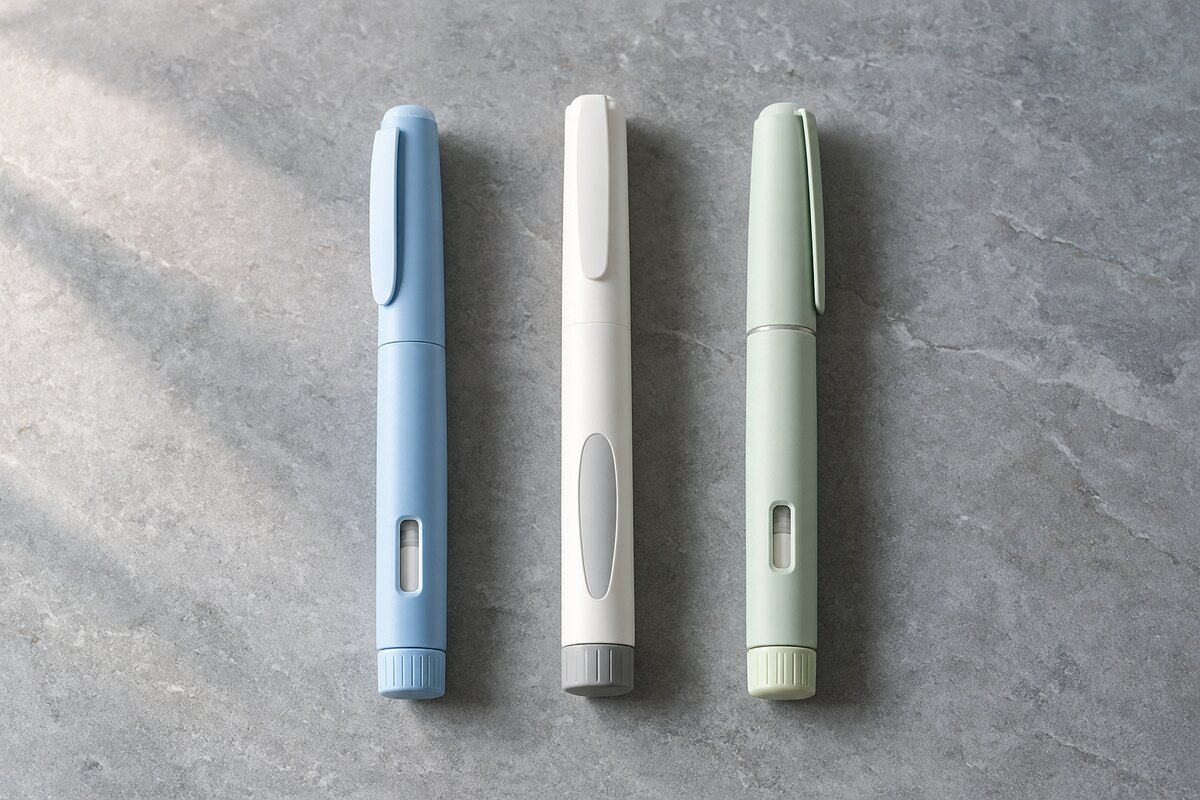
Every approved weight-management label, and the dosage each one names
Five products are approved in the US for chronic weight management in adults. Their labels do not use the phrase "maintenance dosage" in the same way, and one of them does not use it at all. This table is the whole answer to the question, and it is worth reading the right-hand column as carefully as the left.
| Product | Form and frequency | Maintenance dosage the label names for weight reduction in adults | Maximum dosage | Stop rule in the label |
|---|---|---|---|---|
| Wegovy injection (semaglutide) |
Subcutaneous, once weekly | 1.7 mg or 2.4 mg, with 2.4 mg recommended | 7.2 mg, for patients who tolerate 2.4 mg for at least 4 weeks and for whom further reduction is clinically indicated | None |
| Wegovy tablets (semaglutide) |
Oral, once daily on an empty stomach | 25 mg | 25 mg | None |
| Zepbound (tirzepatide) |
Subcutaneous, once weekly | 5 mg, 10 mg or 15 mg | 15 mg | None |
| Saxenda (liraglutide) |
Subcutaneous, once daily | 3 mg. Lower dosages are for titration only. | 3 mg | Yes. Evaluate at 16 weeks and discontinue if the patient has not lost at least 4% of baseline body weight. |
| Foundayo (orforglipron) |
Oral, once daily | None. The label names no maintenance dosage. It describes escalation to the next level after at least 30 days, based on treatment response and tolerability. | 17.2 mg | None |
Three observations fall straight out of that table, and none of them survive the usual summary that "the maintenance dose is whatever worked".
- Only Zepbound offers a genuine choice of maintenance dosage. Its label names three, and tells the prescriber to consider response and tolerability when picking one. Saxenda names a single number. Wegovy names two, plus a conditional third.
- Foundayo has no maintenance dosage at all. It has a starting dosage, five escalation levels and a maximum. The newest approved product in the class is also the one whose label leaves the destination entirely to the prescriber.
- Only Saxenda tells the prescriber when to stop. Its 16-week, 4% rule is the single labelled instruction in this group to discontinue for insufficient response.
Two drugs people assume are on this list, and are not
Ozempic and Mounjaro are not approved for chronic weight management. Ozempic is approved for glycemic control in type 2 diabetes, for reducing major adverse cardiovascular events in type 2 diabetes with established cardiovascular disease, and for kidney outcomes in type 2 diabetes with chronic kidney disease. Mounjaro is approved for glycemic control in type 2 diabetes and for cardiovascular risk reduction in adults with type 2 diabetes at high risk.
This is not pedantry about brand names. It means those two labels contain no maintenance dosage for weight reduction, because weight reduction is not what they were approved to do. If you are taking either one and the goal is weight, the dosing instructions you are following were written about blood sugar, and the maintenance question has to be answered by your prescriber rather than by the document.
What happens when people stop, drug by drug
The labels say what dose to take. They do not say what happens if you come off it. That question has been tested separately for each molecule, and the trials do not all have the same shape, so the results are not directly comparable. What they share is a direction.
| Molecule | Trial | What was compared | Result |
|---|---|---|---|
| Semaglutide 2.4 mg | STEP 4, 2021 | After a 20-week run-in to 2.4 mg, 803 adults randomised 2:1 to continue or switch to placebo for 48 weeks | Body weight change from week 20 to week 68 was -7.9% with continued semaglutide and +6.9% with placebo, a difference of 14.8 percentage points |
| Tirzepatide | SURMOUNT-4, 2024 | After 36 weeks at maximum tolerated dose, 670 adults randomised to continue or switch to placebo | From week 36 to week 88, the placebo group gained 14.0% of body weight while the continued group lost a further 5.5% |
| Tirzepatide | SURMOUNT-MAINTAIN, 2026 | After 60 weeks at maximum tolerated dose, 378 adults randomised to continue at that dose, reduce to 5 mg, or switch to placebo for 52 weeks | At week 112, weight change from baseline was -21.9% continuing, -16.6% at 5 mg and -9.9% on placebo |
| Orforglipron | ATTAIN-MAINTAIN, 2026 | Adults previously treated with tirzepatide (205) or semaglutide (171) in SURMOUNT-5, randomised to oral orforglipron or placebo | At week 52, those who reached a weight plateau maintained 74.7% of their reduction on orforglipron against 49.2% on placebo after tirzepatide, and 79.3% against 37.6% after semaglutide |
Liraglutide is deliberately missing from that table. There is no modern continue-versus-stop trial of Saxenda 3 mg in this format. Its maintenance evidence is the SCALE Maintenance study, which asked a different question: participants first lost at least 5% of their weight on a low-calorie diet and were only then randomised to liraglutide 3.0 mg or placebo, so it tests whether the drug holds and extends a loss that dieting produced, not whether stopping the drug reverses a loss the drug produced. Treating it as equivalent to the four trials above would be a category error, so it is not listed as one.
The question the labels do not answer: can you go down?
Every label in the first table describes going up. Only the Zepbound label describes going down, and only for one reason: "If patients do not tolerate a maintenance dosage, consider a lower maintenance dosage." Tolerability, not success. No approved label in this group contains an instruction that begins "after reaching goal weight".
As of 2026 exactly one molecule has randomised evidence on deliberately stepping down while still doing well. SURMOUNT-MAINTAIN reduced people from 10 mg or 15 mg to 5 mg and followed them for a year. Reducing held less weight off than staying put, 16.6% against 21.9%, and far more than stopping, which left the placebo arm at 9.9%. For semaglutide, liraglutide and orforglipron there is no equivalent step-down trial, so the honest answer for those three is that the question has not been tested.
Three things that change your answer, none of which are on a chart
- Which product you are on. Not which molecule, which product. The same molecule under a diabetes approval comes with no weight maintenance dosage at all.
- Whether your weight has actually plateaued, or just paused. A plateau is a trend over weeks. Both the ATTAIN-MAINTAIN analysis and the ordinary clinical judgement turn on having reached one, and a single week's reading cannot tell you.
- How the current dose is landing. Tolerability is the one factor every label in the table tells the prescriber to weigh, and the only labelled route to a lower dose. It is also the input that is hardest to reconstruct from memory months later.
The first of those three you know. The second and third are a record, and the record is only as good as what was written down at the time.
Frequently asked questions
Is there a standard GLP-1 maintenance dose?
No. The five products approved in the US for chronic weight management name different maintenance dosages, in different units, on different schedules, and Foundayo names none at all. There is no class-wide number, so the only correct answer is the one in the label for the product you were prescribed.
Can I take a lower GLP-1 dose to maintain my weight loss?
That has been tested for one molecule. In SURMOUNT-MAINTAIN, adults reduced from their maximum tolerated tirzepatide dose to 5 mg were at -16.6% of baseline body weight at week 112, against -21.9% for those who stayed at the maximum tolerated dose and -9.9% for those switched to placebo. For semaglutide, liraglutide and orforglipron there is no equivalent randomised step-down trial, so the question has not been answered the same way. Any dose change is a prescriber decision.
What happens if I stop my GLP-1 once I reach my goal?
Every withdrawal trial run so far points the same direction. In STEP 4 the group switched to placebo gained 6.9% of body weight from week 20 to week 68 while those who continued semaglutide lost a further 7.9%. In SURMOUNT-4 the placebo group gained 14.0% from week 36 to week 88. In SURMOUNT-MAINTAIN, 67% of the placebo arm regained at least half of what they had lost.
Is Ozempic or Mounjaro approved for weight maintenance?
Neither is approved for chronic weight management. Ozempic is indicated for glycemic control in type 2 diabetes, for reducing major adverse cardiovascular events in type 2 diabetes with established cardiovascular disease, and for kidney outcomes in type 2 diabetes with chronic kidney disease. Mounjaro is indicated for glycemic control in type 2 diabetes and cardiovascular risk reduction in adults with type 2 diabetes at high risk. Their labels therefore name no maintenance dosage for weight reduction.
Does any label tell you when to stop a GLP-1?
One does. The Saxenda label instructs the prescriber to evaluate the change in body weight 16 weeks after initiation and to discontinue if the patient has not lost at least 4% of baseline body weight, because meaningful weight loss is then unlikely with continued treatment. No other label in this group contains an equivalent rule.
Why do the maintenance doses differ so much between these drugs?
They are different molecules with different potencies, routes and schedules. 3 mg of liraglutide daily, 2.4 mg of semaglutide weekly and 15 mg of tirzepatide weekly are not comparable quantities, and the oral products are dosed higher still because far less of an oral dose reaches the bloodstream. The milligram numbers cannot be compared across rows of the table.
Related reading
- Tirzepatide maintenance dose after weight loss, for the molecule with the only step-down trial behind it
- Zepbound maintenance dose after goal weight, for what that label does and does not say about reaching a goal
- Mounjaro vs Ozempic vs Wegovy, for how the approvals differ before dosing even comes up
- Ozempic vs Wegovy, two brands of the same molecule with two different indications
- Zepbound 7.5 mg weight loss, on a strength that sits between two maintenance dosages
- GLP-1 tracker app, for holding the dose and tolerability history this decision runs on
Sources
- WEGOVY (semaglutide) injection and tablets, US prescribing information on DailyMed. Section 2.2 for the injection maintenance dosages of 1.7 mg and 2.4 mg and the conditional 7.2 mg maximum, section 2.3 for the 25 mg tablet maintenance dosage.
- ZEPBOUND (tirzepatide) US prescribing information, Eli Lilly and Company. Section 2.2 for the three maintenance dosages and the 15 mg maximum, section 2.1 for the lower-maintenance-dosage instruction on tolerability.
- SAXENDA (liraglutide) US prescribing information on DailyMed. Section 2.2 for the 3 mg adult dosage, the titration-only statement and the 16-week, 4% discontinuation rule.
- FOUNDAYO (orforglipron) US prescribing information, Eli Lilly and Company. Section 2.1 for the 0.8 mg starting dosage, the escalation levels and the 17.2 mg maximum. Checked for a maintenance dosage, which the label does not name.
- MOUNJARO (tirzepatide) label on DailyMed, section 1, for the type 2 diabetes and cardiovascular indications and the absence of a weight management indication.
- Rubino D et al. Effect of Continued Weekly Subcutaneous Semaglutide vs Placebo on Weight Loss Maintenance in Adults With Overweight or Obesity: The STEP 4 Randomized Clinical Trial. JAMA. 2021;325(14):1414-1425. PMID 33755728. Trial registration NCT03548987.
- Aronne LJ et al. Continued Treatment With Tirzepatide for Maintenance of Weight Reduction in Adults With Obesity: The SURMOUNT-4 Randomized Clinical Trial. JAMA. 2024;331(1):38-48. PMID 38078870.
- Tirzepatide for maintenance of bodyweight reduction in people with obesity in the USA (SURMOUNT-MAINTAIN). Lancet. 2026;407(10545):2305-2318. PMID 42119587. Trial registration NCT06047548.
- Orforglipron for maintenance of body weight reduction: the double-blind, randomized phase 3b ATTAIN-MAINTAIN trial. Nat Med. 2026;32(7):2679-2687. PMID 42120723. Trial registration NCT06584916.
- Wadden TA et al. Weight maintenance and additional weight loss with liraglutide after low-calorie-diet-induced weight loss: the SCALE Maintenance randomized study. Int J Obes. 2013;37(11):1443-1451. PMID 23812094, cited here only to identify the liraglutide maintenance evidence, which asks a different question from the four withdrawal trials above.
This page summarises published prescribing information and peer-reviewed trial results for general education. It is not medical advice and it contains no dosing recommendation. Which dosage you take, and whether it ever changes, is a decision for the prescriber who knows your response, your tolerability and your other conditions. Never start, stop or change a prescribed medicine on the basis of a web page.
Jabby is free on the App Store and records each dose with its date, its injection site and the side effects that followed it, which turns the tolerability question into something you can show rather than summarise.