The plan, in one paragraph
A Zepbound diet plan is not a calorie-restriction plan. The drug already suppresses appetite, so the hard part is fitting enough protein and fibre into a much smaller volume of food. Build every meal the same way: a palm-sized protein first, then one to two cups of non-starchy vegetables, then a small portion of a whole grain or starch, then a thumb of fat. Eat the protein before anything else on the plate. Aim for the fibre range the National Library of Medicine gives for adults, 21 to 38 grams a day, and spread protein across three eating occasions rather than loading it into dinner. The full seven-day grid, a protein-portion table and a printable version are all below on this page, with no download and no email address required.
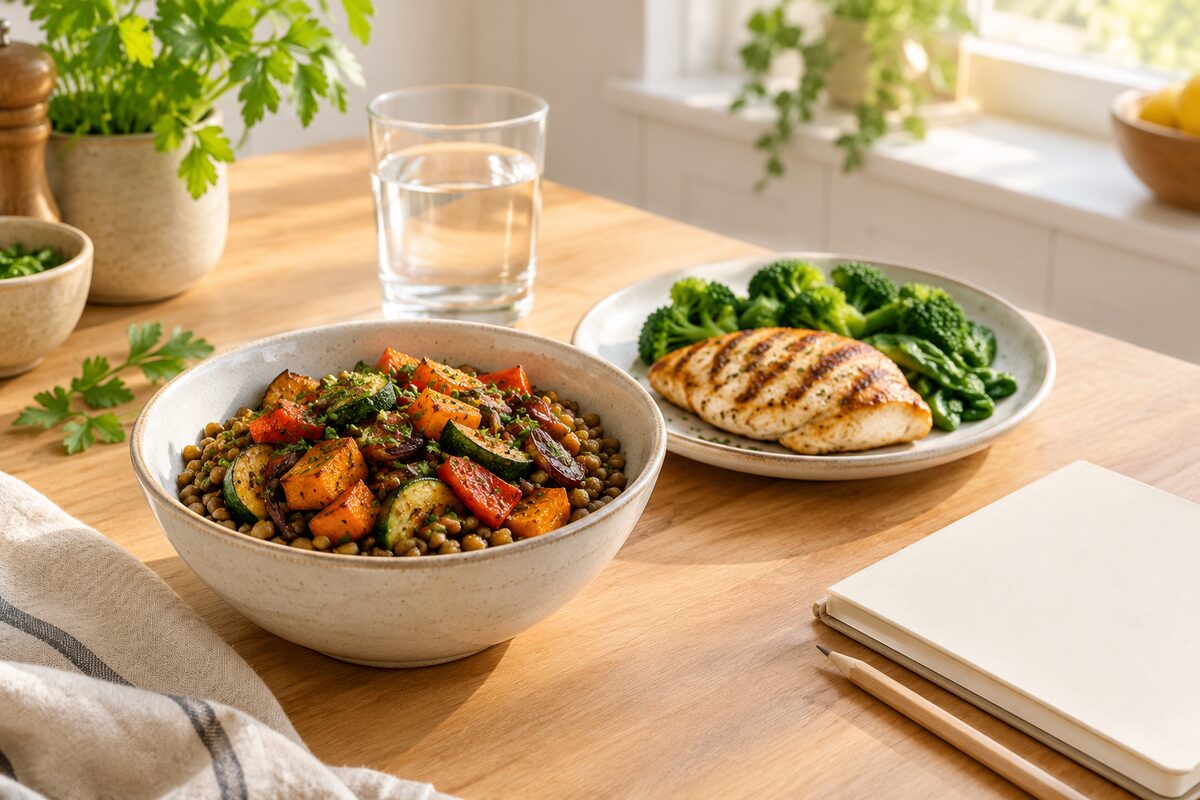
Nearly every "Zepbound diet plan PDF" on the first page of Google is a lead magnet. You give an email address and receive three days, or you pay for a printable on a marketplace, or you download a file whose author line is still a placeholder. This page takes the opposite approach: the plan is the page. Print it, screenshot it, ignore it, it is all the same to us.
Why protein comes first, and the number behind it
The strongest argument for a protein-forward plate on tirzepatide is not a wellness talking point, it is a body-composition finding from the drug's own pivotal trial. In a substudy of SURMOUNT-1, 160 participants had DXA scans at baseline and at week 72. Weight fell 21.3 per cent, fat mass fell 33.9 per cent, and lean mass fell 10.9 per cent. Across the group, roughly 75 per cent of the weight lost was fat and 25 per cent was lean mass, and that proportion held across sex, age and the size of the weight loss (Diabetes, Obesity and Metabolism, 2025).
A quarter of the loss being lean tissue is not unique to tirzepatide; the placebo group in the same substudy lost lean mass in a similar proportion. But it does set the priority. When total food volume collapses because of appetite suppression, protein is the thing most likely to get squeezed out, and it is the one input most worth protecting. This is also why resistance training belongs in a Zepbound eating plan even though it is not food.
How much protein, in portions rather than grams
Gram targets are hard to apply at a kitchen counter. The National Library of Medicine gives a conversion that makes it simple: one ounce of most protein-rich foods supplies about 7 grams of protein, and it lists the ounce equivalents directly (MedlinePlus, Protein in diet). Recommended protein intake for healthy adults is 10 to 35 per cent of total calories, which on a 2,000 calorie day works out to roughly 50 to 175 grams. Where you sit in that range during medically supervised weight loss is a question for your prescriber or a registered dietitian, not for a web page.
| One ounce equivalent | Approximate protein | A realistic portion on Zepbound |
|---|---|---|
| 1 oz meat, fish or poultry | about 7 g | 3 oz cooked, roughly a palm, gives about 21 g |
| 1 large egg | about 7 g | Two eggs give about 14 g and are often tolerated when meat is not |
| ¼ cup tofu | about 7 g | 1 cup gives about 28 g and blends into soups when chewing feels like work |
| ½ cup cooked beans or lentils | about 7 g | 1 cup gives about 14 g plus a useful amount of soluble fibre |
| Low fat dairy, yoghurt or milk | varies by product | Liquid and semi-liquid protein is the easiest win on a low-appetite day |
The fibre half of the plan, and the part that is usually wrong
Fibre guidance for adults is 21 to 38 grams a day, against an average American intake of about 16 grams (MedlinePlus, Fiber). The detail that matters on this drug is that the two kinds of fibre do opposite things. Soluble fibre attracts water, turns to gel and slows digestion. Insoluble fibre adds bulk and helps move food through the stomach and intestines more quickly.
Zepbound already delays gastric emptying; that is stated in the drug interactions section of its prescribing information. So if you are the kind of person who feels full for hours and is fighting constipation, loading up on soluble fibre and fibre supplements can make the fullness worse rather than better. Vegetables and whole grains, which carry more insoluble fibre, are usually the better lever. If constipation is the dominant problem, our guide to which laxative class actually fits this drug goes through the mechanism in detail.
The plate formula
Every meal in the week below is the same four-step build. The order is deliberate: when appetite stops abruptly, whatever you ate first is what you actually got.
- Protein first. A palm-sized portion, eaten before the rest of the plate.
- Non-starchy vegetables. One to two cups. This is where most of the day's fibre comes from.
- A starch or whole grain. A small portion, about half a cupped hand. Not banned, just last in line.
- A fat. A thumb-sized amount. Olive oil, avocado, nuts or seeds.
Seven-day Zepbound meal plan
These are templates, not prescriptions. Nothing here is portioned for a specific calorie target, because the right target depends on your starting weight, your other conditions and your clinician. Swap any protein for an equivalent from the table above.
| Day | Morning | Midday | Evening | If appetite drops |
|---|---|---|---|---|
| 1 | Greek yoghurt with raspberries and a spoon of chia | Grilled chicken, mixed leaves, chickpeas, olive oil | Baked salmon, broccoli, small portion of quinoa | Keep the yoghurt, drop the quinoa |
| 2 | Two scrambled eggs, spinach, one slice wholegrain toast | Lentil and vegetable soup with a wholegrain roll | Turkey meatballs, courgette, tomato sauce | Soup only, with extra lentils |
| 3 | Cottage cheese with pear and walnuts | Tuna and white bean salad, cucumber, lemon | Stir-fried tofu, mixed peppers, brown rice | Cottage cheese and fruit twice |
| 4 | Protein smoothie, milk or soy, berries, oats | Leftover tofu stir-fry over leaves | Roast chicken thigh, green beans, small sweet potato | Smoothie as the evening meal |
| 5 | Overnight oats with milk and ground flaxseed | Egg and avocado on wholegrain, side salad | White fish, ratatouille, barley | Oats, then fish without the barley |
| 6 | Omelette with mushrooms and tomato | Chicken and black bean bowl, salsa, shredded cabbage | Lean beef or lentil chilli, cauliflower rice | Chilli reheated small, twice |
| 7 | Kefir or yoghurt with seeds and blueberries | Minestrone with beans, parmesan | Prawns, asparagus, wild rice | Minestrone with extra beans only |
What to eat on Zepbound when you are not hungry at all
This is the question the standard meal plan never answers, and it is the one most people actually have. Appetite suppression is the drug working, not a problem to fix, but skipping protein for three days running is a problem. The fourth column of the table above exists for this. The practical rules:
- Shrink the meal, not the protein. Drop the grain and the fat before you drop the chicken.
- Drink it. Milk, kefir, a yoghurt drink or a blended soup delivers protein without the work of chewing a plate of food.
- Eat on a clock, not on hunger. Three small eating occasions at set times beats waiting for an appetite signal that may not arrive.
- Front-load the day. For many people appetite is best in the morning and worst in the evening, so the biggest protein portion belongs at breakfast.
Foods to avoid, and which ones actually matter
There is no banned-foods list in the Zepbound label. What exists is a side-effect profile, and some foods reliably make it worse. In the pooled trials behind the label, nausea was reported by 25 to 29 per cent of people on Zepbound against 8 per cent on placebo, and diarrhoea by 19 to 23 per cent against 8 per cent. Those are the reactions most sensitive to what is on the plate.
| Food or drink | Why it tends to cause trouble | Usual adjustment |
|---|---|---|
| Fried and very high-fat meals | Fat slows stomach emptying further, on top of the drug's own effect | Keep fat to a thumb-sized portion per meal rather than cutting it out |
| Large portions of any kind | Volume, not content, is the most common trigger for nausea and reflux | Halve the serving and keep the second half for later |
| Alcohol | Irritates the stomach, adds calories with no protein, and can mask early fullness | A question for your prescriber, particularly if you have had nausea |
| Sugary drinks and juice | Calories without protein or fibre, in a day when total intake is already small | Water, milk or unsweetened drinks instead |
| Very spicy or acidic food | Associated with reflux, which the label lists as a reported reaction | Reduce rather than remove, and note which ones affect you |
Logging that makes this plan testable
The weak point of any eating plan on a weekly injection is that the two things interact. Nausea and appetite usually peak in the days just after a dose, which means the same meal can feel fine on day six and impossible on day two. Without a record, that pattern is invisible, and people end up blaming a food that was never the problem.
This is the one place where a tracker earns its keep. Logging what you ate against the day of your injection cycle, alongside the symptom, turns a vague sense that "food is harder lately" into a pattern you can plan meals around and show a clinician. Jabby records dose dates, injection sites and side effects on the same timeline, so the day-of-cycle view is there without extra work.
Track meals against your dose cycle
Log doses, sites and symptoms in one place, then see which days of your cycle actually need the lighter meal plan.
Download Jabby - Free on App StoreFrequently asked questions
Do I need to count calories on Zepbound?
The label states the drug is indicated as an adjunct to a reduced-calorie diet and increased physical activity, so a calorie deficit is part of the approved use. Whether you need to count it formally is a different question, and for many people the appetite effect produces the deficit without arithmetic. The risk of counting without a protein target is hitting a low calorie number while under-eating protein. If you want a number, ask your prescriber or a registered dietitian for one based on your own weight and labs.
Is there a free Zepbound diet plan PDF?
Several exist, but most of the ones ranking for that phrase require an email address, charge for the full week, or are published without an identifiable author or reviewer. The seven-day grid on this page is the same content without the gate. Your browser's print function will produce a clean copy of it.
How much protein should I eat on Zepbound?
Published general guidance for healthy adults is 10 to 35 per cent of total calories. We will not give you a gram target for weight loss on a GLP-1, because that number depends on your body weight, kidney function and other conditions, and getting it from a web page rather than a clinician is how people end up on an inappropriate intake. Use the portion table above to build meals and take the target itself to your prescriber.
Can I follow a vegetarian or vegan plan on Zepbound?
Yes. The ounce-equivalent table includes tofu and cooked beans or lentils, and days 3, 5 and 7 above are straightforward to make meat-free. The practical difficulty is that plant proteins come packaged with more soluble fibre, which slows digestion further, so people who are already struggling with fullness may do better with soy, dairy or protein drinks than with large portions of beans.
What should I eat on the day of my injection?
There is no official instruction to eat differently on injection day, and the label does not tie dosing to meals. What people report, and what logging tends to confirm, is that the two or three days following a dose are when smaller, lower-fat, lower-volume meals are easiest. Track it for one cycle before you restructure your week around it.
Will eating more protein stop the lean mass loss?
No published evidence shows that a particular protein intake eliminates the lean mass component of weight loss on tirzepatide, and the SURMOUNT-1 substudy did not test diet or exercise interventions. What it establishes is the proportion, roughly three quarters fat to one quarter lean. Protein intake and resistance training are the standard clinical levers for protecting lean tissue during any weight loss, which is why they are built into this plan, but treat them as sensible rather than proven for this drug.
Related guides
- Best laxative for Zepbound constipation: why bulk-forming fibre is usually the wrong first move, with onset times by class
- Not losing weight on Zepbound 15 mg: what the trial numbers actually say about where you should be
- How to reduce Zepbound side effects: the timing patterns behind nausea and fatigue
- GLP-1 tracker app: logging doses, sites and symptoms on one timeline
Sources
- National Library of Medicine. Protein in diet, MedlinePlus Medical Encyclopedia. Read 8 October 2026. Source for: 10 to 35 per cent of total calories; 1 gram of protein supplies 4 calories; one ounce of most protein-rich foods contains about 7 grams of protein; the ounce equivalents for meat, egg, tofu and cooked beans or lentils.
- National Library of Medicine. Fiber, MedlinePlus Medical Encyclopedia. Read 8 October 2026. Source for: the 21 to 38 gram adult recommendation; the 16 gram average intake; soluble fibre attracting water, forming a gel and slowing digestion; insoluble fibre adding bulk and speeding transit.
- Eli Lilly and Company. ZEPBOUND (tirzepatide) injection prescribing information. Read 8 October 2026. Source for: the adjunct-to-reduced-calorie-diet indication; delayed gastric emptying and its effect on oral medications; nausea 25 to 29 per cent and diarrhoea 19 to 23 per cent against 8 per cent on placebo; reflux as a reported reaction.
- Look M, et al. Body composition changes during weight reduction with tirzepatide in the SURMOUNT-1 study of adults with obesity or overweight. Diabetes, Obesity and Metabolism, 2025. PMID 39996356. Source for: the 160-participant DXA substudy; weight down 21.3 per cent, fat mass down 33.9 per cent and lean mass down 10.9 per cent at week 72; approximately 75 per cent fat and 25 per cent lean mass across subgroups.
This page is information, not medical advice, and it is not a prescription for a calorie or protein target. It does not recommend a dose or a change to your treatment. Your prescribing information, your prescriber and a registered dietitian take precedence over anything written here, particularly if you have diabetes, kidney disease or any condition that affects what you can safely eat.