Short answer: the pen does not include needles, and you need four per pen
The Zepbound KwikPen ships without pen needles. Lilly's Instructions for Use lists "KwikPen-compatible Pen Needle" under supplies and marks it not included. Lilly states the pen accepts any pen needle compliant with ISO 11608-2, from brands such as Embecta (formerly BD), Novo Nordisk and Terumo, in lengths of 4, 5, 6, 8 and 12.7 mm and gauges of 29G to 34G, and refers the choice of size to your prescriber. One pen holds 4 fixed weekly doses and a new needle is required for every injection, so the floor is 4 needles per pen, plus spares for the two situations below where the Instructions for Use tells you to change one mid-dose.
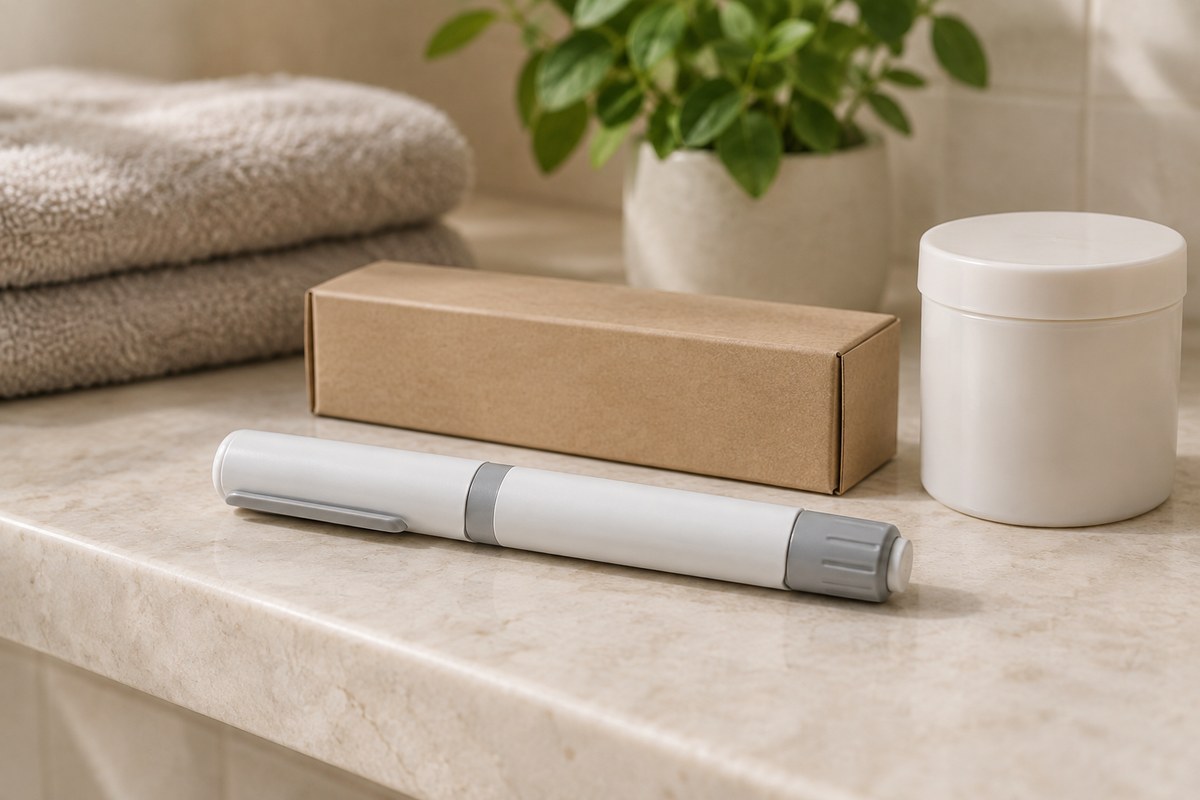
The pharmacy hands you a carton with a pen in it, you open the box the night before your first dose, and there is nothing to screw on the end. That is not an error and nothing is missing. Pen needles are a separate item, and the rest of this page is the detail that box does not tell you.
Which pen needles fit the KwikPen
The KwikPen uses the same standard threaded fitting as most modern injection pens, which is why the compatibility list is unusually wide. Lilly's published needle compatibility guidance for the Zepbound KwikPen gives the following, and states plainly that not all length and gauge combinations are commercially available.
| What Lilly specifies | Detail | What it means at the pharmacy counter |
|---|---|---|
| Standard | Pen needles compliant with ISO 11608-2 | The compliance mark, not the brand, is what decides fit. A needle sold for an insulin pen to this standard fits the same thread. |
| Brands named | Embecta (formerly BD), Novo Nordisk, Terumo | These are examples, not an exclusive list. Store-brand needles that state ISO 11608-2 compliance are covered by the same statement. |
| Lengths | 4 mm, 5 mm, 6 mm, 8 mm, 12.7 mm | All five are listed as compatible. Which one suits you is a clinical question, not a fit question. |
| Gauges | 29G, 30G, 31G, 32G, 33G, 34G | Higher number means a thinner needle. Thinner needles are not universally better; the trade-off is a discussion for your prescriber. |
| Availability caveat | Not all length and gauge combinations are sold | A size can be compatible and still not exist on a shelf. Check the combination before ordering a large box. |
On needle size specifically
Lilly's compatibility page does not recommend a length or a gauge, and neither do we. It says to consult your healthcare provider for pen needle recommendations and for guidance on proper injection technique. If you have seen a specific size named confidently elsewhere on the internet, that was somebody's opinion, not the manufacturer's instruction.
How many needles one KwikPen actually consumes
Most pages answer this with "about four or five". Here is where the number comes from, and where it can move.
- One pen holds 4 fixed doses, taken one per week. The Instructions for Use states this at the top and notes the pen prevents you from dialling a full dose after the fourth.
- Every injection needs a new needle. The Instructions for Use is explicit: always use a new pen needle for each injection, to help prevent infections and blocked needles.
- Priming does not cost an extra needle in the normal case. You prime before each weekly injection, using the needle already fitted for that injection. Priming and injecting share one needle.
- Two situations do cost an extra needle. If no medicine appears at the needle tip after repeating the priming steps twice, the Instructions for Use says to change the pen needle and prime again. Separately, if the dose knob is hard to push, it lists a blocked needle as a cause and says to fit a new needle and prime.
So the floor is 4 needles per pen and the realistic buy is 4 plus a spare or two per pen. Scaled out, at four doses per pen and one dose per week, weekly dosing consumes about 52 needles a year before spares. A single 100-count box is therefore roughly two years of supply, and even with generous spares it is well over a year. If you are about to order needles by the hundred, that is worth knowing before you buy three boxes.
The 30-day clock nobody mentions on a needles page
This is the rule that decides when a pen is finished, and it is not the needle count.
The Instructions for Use gives two independent end conditions for a KwikPen. Throw the pen away after 4 weekly doses. And throw the pen away 30 days after first use, even though the pen has medicine left in it. Whichever comes first, that pen is done.
Do the arithmetic on a clean weekly schedule. Dose one on day 0, then day 7, day 14, and dose four on day 21. That leaves nine days of slack against the 30-day limit for the whole pen. Shift your injection day later by an average of more than about three days per dose and you reach day 30 with medicine still in the cartridge, which you cannot use.
The decision rule
Write down the date you first used the pen, not just the dates you inject. The needle count tells you nothing about this. Four doses and thirty days are two separate clocks running at once, and only one of them is visible on the pen.
Why the needle has to come off after every dose
After injecting, the Instructions for Use says to replace the outer needle shield, unscrew the capped needle and put it in a sharps container. It then gives three specific reasons not to store the pen with a needle attached: to prevent leaking, to prevent the needle blocking, and to prevent air entering the pen.
That third reason is the one that connects to the rest of the routine. Air in the cartridge is exactly what priming exists to clear, which is why the pen has to be primed before every weekly injection rather than only once. Leaving the needle on creates the problem that the next prime then has to fix, and a blocked needle is one of the two situations that costs you a spare.
Two related instructions from the same document, both worth reading once: do not store the pen without the pen cap attached, and never share a pen with another person even if the needle has been changed, because of the risk of passing a serious infection in either direction.
Buying, storing and disposing
Where they come from
Pen needles are stocked at pharmacy counters and by mail-order pharmacies, and they are not part of the Zepbound carton. Whether your plan covers them, and whether it wants a prescription on file in order to cover them, varies by plan and by state. The practical move is to ask the pharmacy that fills your Zepbound to put needles on the same order, so the two arrive together rather than one arriving without the other.
Storing the pen itself
- Unused pens: refrigerated between 36°F and 46°F (2°C to 8°C), usable until the printed expiry if kept there. Do not freeze; a frozen pen is discarded.
- A pen already in use: may be stored at room temperature up to 86°F (30°C) after your injection, away from heat and light.
- Both: keep pens and needles out of the sight and reach of children.
Disposal
Used needles go into an FDA-cleared sharps disposal container right away after use, and loose needles must never go into household trash. If you do not have an FDA-cleared container, the Instructions for Use describes what an acceptable household substitute looks like: heavy-duty plastic, closeable with a tight-fitting puncture-resistant lid that sharps cannot come back out of, upright and stable in use, leak-resistant, and properly labelled to warn of hazardous waste inside.
When the container is nearly full, your community's rules decide how it is disposed of, and those rules differ by state. Lilly points readers to the FDA's safe sharps disposal guidance at fda.gov/safesharpsdisposal. The used pen itself, once the needle is off, goes in household trash or in the sharps container.
Where you inject, and why it is a separate record
The Instructions for Use lists the thigh or the stomach at least two inches from the belly button for self-injection, and the back of the upper arm when another person is giving it. It then says to change, or rotate, your injection site each week: you may use the same area of the body, but choose a different site within that area.
Rotation only works if you can remember where the last one went, and after a few weeks nobody can. That is the gap between an instruction and a habit, and it is the thing this site exists to close. Jabby maps each injection to a site so the rotation is a record rather than a recollection, keeps the dose and date history that tells you which of the four doses in the current pen you are on, and logs side effects against the dose they followed so you can see whether a sore spot tracks a particular area. For the KwikPen specifically, the useful field is the one this article is about: the date you first used the pen, so the 30-day clock is not something you have to hold in your head.
Track the pen, not just the dose
Dose history, first-use date, site rotation and side effects in one weekly log. Free on the App Store.
Download Jabby - Free on App StoreFrequently asked questions
Can I reuse a pen needle to save one?
The Instructions for Use says to use a new pen needle for every injection, and names the two reasons: to help prevent infections and to help prevent blocked needles. A blocked needle is also what makes the dose knob hard to push, so a reused needle tends to cost you the needle you were trying to save.
Is a 4 mm needle enough, or do I need a longer one?
Lilly lists 4, 5, 6, 8 and 12.7 mm as compatible and does not pick one. Length interacts with technique and with the individual, which is why the manufacturer routes the question to your healthcare provider rather than answering it. Ask at the appointment where your prescription is written, and the pharmacist can confirm what that size is actually stocked in.
What if my pen will not prime?
The Instructions for Use gives a bounded sequence: repeat the priming steps no more than two additional times; if there is still no medicine at the tip, change the pen needle and repeat once more; if it still does not prime, contact Lilly at 1-800-545-5979. It also says not to redial or repeat a dose if you are unsure, and to speak to your healthcare provider.
Are safety pen needles required?
Lilly's compatibility statement is written around the ISO 11608-2 standard and does not require a safety-engineered needle for home self-injection. Some workplaces and care settings do require them, and some people simply prefer the shielded design. It is a preference and a policy question rather than a fit question.
Is the KwikPen the same as the single-dose pen?
No. The KwikPen is described in its own Instructions for Use as a disposable multi-dose single-patient-use prefilled pen holding 4 fixed doses. A single-dose pen is finished after one injection and has its own instructions. Check which device your carton contains before following any handling guidance, including this page.
What happens if I still have medicine left after four doses?
The Instructions for Use is direct about this: after 4 doses, discard the pen including the unused medicine, do not inject the leftover, and do not transfer it into a syringe. The pen is built to stop you dialling a full dose past the fourth, and attempting to use what remains risks an incomplete dose.
Related reading
- Zepbound reviews, patient ratings, physician ratings and trial data side by side
- Zepbound injection site reactions, what the label reports by dose and why rotation is in the instructions
- Tirzepatide guide, the medicine inside the pen
- Tracking tirzepatide injections, dose and site logging week to week
- Injection tracking app guide, site rotation and dose history in one place
- GLP-1 tracker app overview, for the wider weekly routine
Sources
- Eli Lilly and Company. Instructions for Use: ZEPBOUND KwikPen (tirzepatide) injection, for subcutaneous use, multi-dose single-patient-use prefilled pen. United States version, pi.lilly.com/us/zepbound-kwikpen-us-ifu.pdf. Read 29 September 2026. Source for: 4 fixed doses per pen; pen needle not included; a new needle for each injection; priming before each weekly injection and the bounded re-prime sequence; the instruction not to store the pen with a needle attached and its three stated reasons; storage temperatures; the 30-day discard rule; sharps and household container disposal criteria; injection sites and weekly site rotation.
- Eli Lilly and Company. Zepbound KwikPen needle recommendation (medicine FAQ, Lilly Canada). Read 29 September 2026. Source for: ISO 11608-2 compliance; the brands named as examples; lengths 4, 5, 6, 8 and 12.7 mm; gauges 29G to 34G; the statement that not all length and gauge combinations are commercially available; the referral of size choice to a healthcare provider.
- US Food and Drug Administration. Safely Using Sharps (Needles and Syringes) at Home, at Work and on Travel, fda.gov/safesharpsdisposal, cited by Lilly's Instructions for Use for state-level disposal rules.
This page is information, not medical advice. It describes how the device is documented to be handled and does not recommend a dose, a needle size or a change to your treatment. Your approved prescribing information and your prescriber take precedence over anything written here, and the leaflet in your own carton is the version that applies to your device.