Short answer: it depends on which Mounjaro device you were given, and the label names no size at all
If you have the Mounjaro single-dose pen, there is no needle size to choose. The needle is already inside the pen behind the grey base cap, you never attach or handle it, and the Instructions for Use tell you not to touch it. If you have the Mounjaro KwikPen, you buy pen needles separately, and Lilly's guidance is that any pen needle compliant with ISO 11608-2 fits, in lengths from 4 mm to 12.7 mm and gauges from 29G to 34G, with 4 mm suitable for adults and the final choice left to your physician or pharmacist. If you have vials, there is no pen needle at all. One thing worth knowing before you read any specific number elsewhere: the US prescribing information and Instructions for Use for Mounjaro never state a gauge or a length.
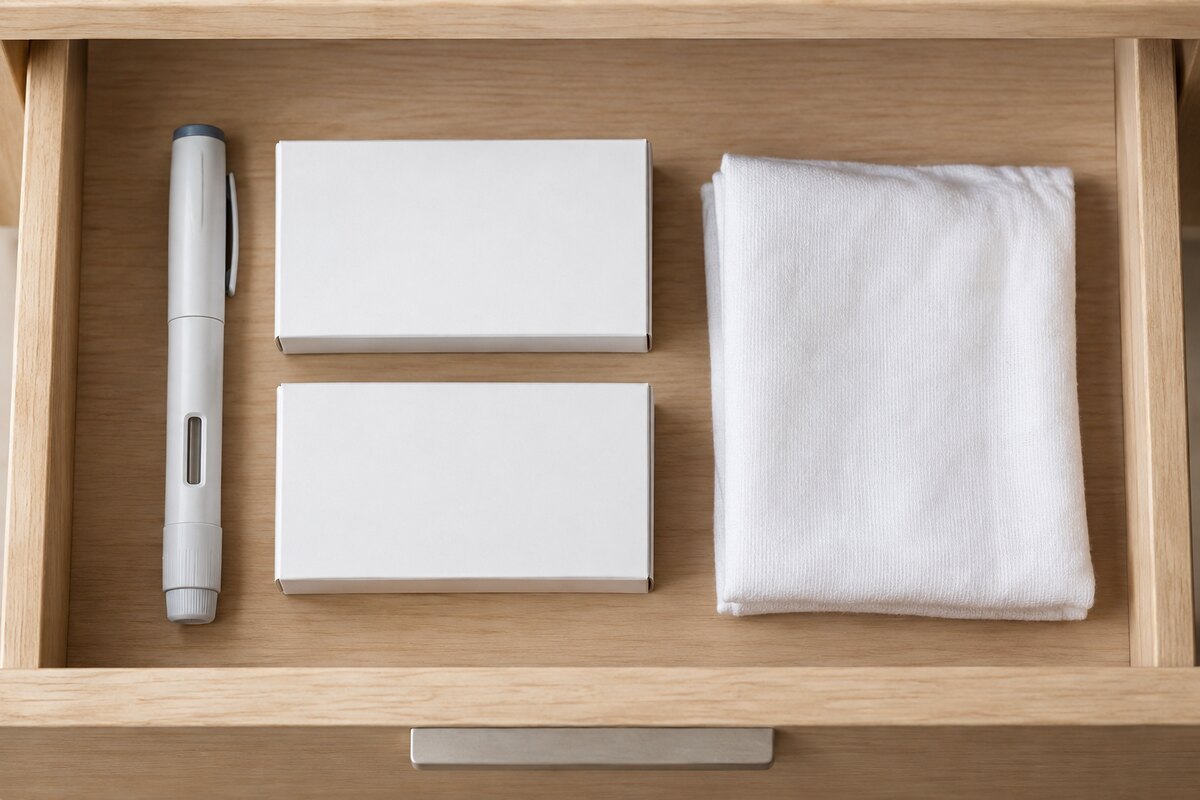
Find your presentation first, because three of the four do not involve a choice
Mounjaro is supplied four ways in the US, and the needle question has a different answer in each row. Almost every page that answers "what size needle for Mounjaro" has silently picked one row and written as though it were the only one.
| What you were dispensed | Do you choose a needle? | What you handle | Who decides the size |
|---|---|---|---|
| Single-dose pen (one pen, one weekly dose) | No | Nothing. The needle sits behind the grey base cap. The Instructions for Use say to pull that cap off, not to put it back on because that could damage the needle, and not to touch the needle. | Nobody. There is no size to pick. |
| KwikPen (one pen, four weekly doses) | Yes | A new KwikPen-compatible pen needle for every injection. The Instructions for Use list it under supplies needed and mark it "not included". | Your prescriber or pharmacist, from the compatible range |
| Single-dose vial | Not a pen needle | A syringe and needle, with a new one for every injection. The label points to a syringe able to measure the 0.5 mL or 0.6 mL dose. | Your prescriber |
| Multi-dose vial (four doses) | Not a pen needle | Same as above, a new syringe and needle each time | Your prescriber |
Worth stating plainly, because it is the single most repeated error on this question: the US prescribing information and the Instructions for Use for Mounjaro do not state a needle gauge or a needle length anywhere. Not for the single-dose pen, not for the KwikPen. If you have read a specific number presented as Mounjaro's needle size, it did not come from the label.
If you have the KwikPen, here is the actual compatible range
Lilly does not manufacture pen needles. Its medical information service answers the compatibility question directly: the KwikPen works with pen needles that comply with ISO 11608-2, and names Embecta (formerly BD), Novo Nordisk and Terumo as examples. The range those cover is wider than most people expect.
- Lengths available: 4 mm, 5 mm, 6 mm, 8 mm and 12.7 mm
- Gauges available: 29G, 30G, 31G, 32G, 33G and 34G, where a higher number means a thinner needle
- Lilly's stated position on length: pen needles of 4 mm are suitable for adult patients
- Who decides: Lilly is explicit that the choice of gauge and length remains at the discretion of the physician or pharmacist, and notes that not every length and gauge combination is commercially available
What "ISO 11608-2 compliant" on the box actually tells you
Two different parts of the same standard turn up on Mounjaro packaging and literature, and they are not interchangeable.
ISO 11608-2 covers the needles. It sets requirements and test methods for single-use, double-ended sterile pen needles intended for needle-based injection systems. A box marked compliant with it is telling you the needle has been built and tested to that specification, which is what makes it a candidate for the KwikPen in the first place.
ISO 11608-1 covers the delivery system. The Mounjaro KwikPen Instructions for Use state that the KwikPen meets the current dose accuracy and functional requirements of ISO 11608-1. That is a statement about the pen delivering the dose you dialled, not about any needle.
So compliance with ISO 11608-2 is a necessary condition, not a guarantee of fit, and it says nothing about which length or gauge suits you. It narrows the shelf. It does not pick off it.
Does a shorter needle work as well? What the evidence says, and where it comes from
The 4 mm recommendation is not a marketing preference, and it is also not drawn from tirzepatide research. Both of the sources behind it come from insulin injection technique, which is worth knowing when you weigh how firmly it applies to you.
The direct comparison is a randomised crossover trial of 173 adults with type 1 and type 2 diabetes, who used a 4 mm 32G pen needle against either a 5 mm 31G or an 8 mm 31G needle over two three-week periods. Glycemic control met the pre-specified equivalence criteria in both comparisons. Reported leakage at the injection site was similar across all three needles. The 4 mm needle was rated significantly less painful and was preferred by roughly two thirds of participants.
The broader guidance is the FITTER recommendations, written and reviewed by 183 diabetes experts from 54 countries and published in Mayo Clinic Proceedings. Its first key recommendation is that the shortest needles, which it identifies as the 4 mm pen needle and the 6 mm syringe needle, are safe, effective and less painful and should be the first-line choice in all patient categories. It also recommends avoiding intramuscular injection, which is the specific risk a longer needle introduces.
The honest caveat is in the trial's own abstract: it calls for further trials in other groups, naming GLP-1 users explicitly. The evidence base is strong, and it was built on insulin.
The rules that are not about size at all
Three instructions in the KwikPen Instructions for Use matter more week to week than the millimetre you settle on, and two of them get broken routinely.
- A new pen needle for every injection. The wording is "Always use a new pen needle for each injection to help prevent infections and blocked needles." A reused needle is the common cause of a pen that will not prime.
- The needle comes off after the dose, not before the next one. Leaving it attached leaves the cartridge open to air and leakage.
- Rotate the site every week. The label's instruction is to rotate injection sites with each dose. FITTER gives the reason: lipohypertrophy is a frequent complication that distorts absorption, injections should not be given into those lesions, and correct site rotation helps prevent them. A needle length cannot compensate for injecting into the same patch for months.
Rotation is the one of the three that depends entirely on memory, because last week's site leaves nothing behind to look at. That is the part worth writing down.
Buying them, and getting rid of them
Pen needles are dispensed separately from the pen and usually need their own prescription or pharmacy request, which catches people out on the first KwikPen refill when the box arrives without them. Used needles go into an FDA-cleared sharps disposal container, or a heavy-duty household container if one is not available, per the Instructions for Use. Never into household recycling.
One more boundary from the Instructions for Use, because it is a question people genuinely ask: "Do not transfer MOUNJARO from your Pen into a syringe." If you have a pen, use the pen. If you have vials, use the syringe your prescriber specified for them.
Frequently asked questions
Does the Mounjaro pen come with a needle?
The single-dose pen does: the needle is built in, behind the grey base cap, and you never see or attach it. The KwikPen does not. Its Instructions for Use list a KwikPen-compatible pen needle under supplies needed and mark it as not included, so you buy those separately, one for each of the four weekly doses in the pen.
What size needle is used for the Mounjaro KwikPen?
Lilly states the KwikPen works with pen needles compliant with ISO 11608-2, which are available in lengths of 4 mm, 5 mm, 6 mm, 8 mm and 12.7 mm and gauges of 29G to 34G. It says 4 mm pen needles are suitable for adult patients and that the choice of gauge and length remains at the discretion of the physician or pharmacist. Not every length and gauge combination is sold.
How long is the needle inside the Mounjaro single-dose pen?
Neither the US prescribing information nor the Instructions for Use states a length or a gauge for the single-dose pen. Any specific figure you find for it has come from somewhere other than the label. It is also not a number you can act on, because the pen gives you no way to change the needle.
Is a 4 mm needle long enough, or will the medicine not go deep enough?
The comparison has been tested, though in insulin users rather than tirzepatide users. In a randomised crossover trial of 173 adults, a 4 mm 32G pen needle met equivalence criteria for glycemic control against 5 mm and 8 mm needles, showed similar injection site leakage, was rated significantly less painful and was preferred by about two thirds of participants. The FITTER recommendations call the shortest needles first-line in all patient categories. Your prescriber or pharmacist makes the choice for you.
Can I reuse a pen needle to save one?
The Instructions for Use say to always use a new pen needle for each injection, to help prevent infections and blocked needles. A reused needle is the usual reason a pen will not prime.
Can I use an insulin syringe with a Mounjaro pen?
No. The Instructions for Use state directly: do not transfer Mounjaro from your Pen into a syringe. If you were dispensed vials rather than a pen, you use a syringe, and the label points to one able to measure the 0.5 mL or 0.6 mL dose. Which syringe and needle is your prescriber's decision.
Does a thinner gauge hurt less?
A higher gauge number means a thinner needle, and thinner needles are generally better tolerated, but the trial evidence above measured length rather than gauge as the main variable: the 4 mm 32G needle was compared against 31G needles at 5 mm and 8 mm. Gauge and length were not separated, so the clean finding is about the shorter needle, not the thinner one on its own.
Related reading
- Zepbound KwikPen needles, the same device question for the other tirzepatide brand, including how many needles one pen consumes
- Best injection sites for Mounjaro, for where the needle goes once you have one
- Mounjaro injection site pictures, for what the sites and the rotation pattern look like
- Tirzepatide injection site reactions, for when a site stays red or lumpy
- Tirzepatide maintenance dose after weight loss, for the dose question behind the device
- GLP-1 tracker app, for keeping the rotation record the label asks for
Sources
- MOUNJARO (tirzepatide) US prescribing information and Instructions for Use, Eli Lilly and Company. Section 2.2 for the four presentations and the syringe guidance for vials, section 2.2 for the instruction to rotate injection sites with each dose, the KwikPen Instructions for Use for the supplies list marking the pen needle not included, the new-needle-each-injection instruction, the ISO 11608-1 statement and the instruction not to transfer Mounjaro into a syringe, and the single-dose pen Instructions for Use for the grey base cap and the instruction not to touch the needle. Checked throughout for a stated gauge or length, which it does not contain.
- What needles are recommended for the Mounjaro (tirzepatide) KwikPen?, Lilly Medical Information. Source of the ISO 11608-2 compatibility statement, the 4 mm to 12.7 mm length range, the 29G to 34G gauge range, the named manufacturers and the statement that the choice remains at the discretion of the physician or pharmacist.
- ISO 11608-2:2022, Needle-based injection systems for medical use, requirements and test methods, part 2: double-ended pen needles, published April 2022, for the scope quoted here: single-use, double-ended, sterile needles intended for needle-based injection systems that use a non-integrated double-ended needle, and the exclusions covering dental, pre-attached syringe, hypodermic and other-route needles.
- Hirsch LJ et al. Comparative glycemic control, safety and patient ratings for a new 4 mm x 32G insulin pen needle in adults with diabetes. Curr Med Res Opin. 2010;26(6):1531-1541. PMID 20429832. Trial registration NCT00928057. Source of the equivalence result, the leakage finding, the pain rating and the two-thirds preference, and of the authors' own call for trials in GLP-1 users.
- Frid AH et al. New Insulin Delivery Recommendations. Mayo Clin Proc. 2016;91(9):1231-1255. PMID 27594187. The FITTER recommendations, for the shortest-needles-first-line position, the warning on intramuscular injection and the lipohypertrophy and site rotation recommendation.
- MOUNJARO label on DailyMed, US National Library of Medicine, for an independently hosted copy of the same label and Instructions for Use.
This page summarises published prescribing information, manufacturer medical information and peer-reviewed research for general education. It is not medical advice and it is not a recommendation of a needle size for you. Needle gauge and length are chosen by your prescriber or pharmacist, who can take your body, your technique and your device into account. Follow the Instructions for Use that came with your own presentation.
Jabby is free on the App Store and records which site took each weekly dose, which is the one part of the label's instructions that nothing on your skin will remind you of a week later.